Andrew Dalziel
Good Morning, Midnight (Reginald Hill Edition)Andrew Dalziel is a bulky, unmistakable presence in the investigation surrounding the Maciver family: forceful enough to redirect a scene simply by arriving, yet less certain beneath that authority than his bluster suggests. His connections to the case run back ten years, to the death of Palinurus Maciver Senior, and forward into the present through his working partnership with Peter Pascoe, his regard for Hat Bowler, and his close friendship with Kay Kafka.
Identity and Introduction
Dalziel enters the scene through mist and headlight glare, his booming voice preceding him. The narration compares his effect to a shark suddenly placed in a swimming pool: he is not soothing, but he gives everyone a new, impossible-to-ignore focus. The metaphor captures both his physical impact and his institutional role. He does not need to take over formally to alter the atmosphere; his arrival makes the stalled scene answer to his attention.
He immediately addresses the ambulance crew and establishes that they are not yet authorized to remove the body. Rather than letting the delay dissolve into routine, he challenges the crew’s apparent readiness to leave. His attention is also on the family members gathered outside. He infers that they have come because they fear the dead person may be Palinurus Maciver Junior, and proposes going inside to resolve their uncertainty. His manner is brusque and teasing, but the movement is practical: the people waiting outside need an answer, and the inquiry needs to establish who has died.
Authority and the Present Inquiry
Dalziel’s first exchange with Peter Pascoe defines their working arrangement through friction rather than ceremony. Pascoe asks whether Dalziel is assuming control; Dalziel declines, reasoning that Pascoe arrived first and therefore remains in charge. The exchange leaves Pascoe responsible for the immediate investigation while making clear that Dalziel’s senior presence is still consequential. He can defer formal command without becoming peripheral.
The two men sit together at the head of the staircase, a position that turns the house into a place of recollection as well as investigation. When Pascoe asks where Dalziel was ten years earlier, Dalziel says he was in this same house for much the same reason. On that day, Palinurus Maciver Senior died by suicide in his locked study, using a Purdy shotgun and an improvised arrangement involving string and the trigger. Dalziel’s memory makes the present death inquiry part of a painful recurrence: the current family crisis occupies a house already marked by an earlier death, on its anniversary.
Dalziel’s assurance that this is a simple suicide does not erase that history. The present case is still under examination, and his own past presence in the house gives the scene a personal weight distinct from the procedural question of who is in charge. His characteristic certainty operates alongside, not instead of, that accumulated knowledge.
Command, Doubt, and the CID
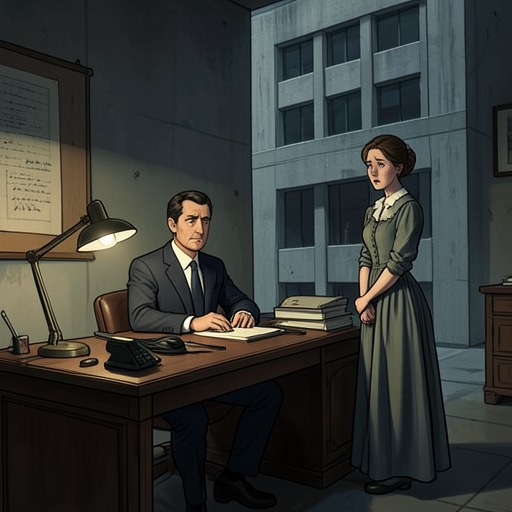
At Mid-Yorkshire CID, Dalziel’s public identity is that of a superintendent whose officers wait for direction. The narration presents him at his office window, apparently looking out over the bright spring landscape while listening to a tape. He is not listening to the tape Pascoe has left on his desk, but to the original of another recording. Its association with the Palinurus Maciver Senior suicide files troubles him: he does not know how it came to be stored with those materials, and the possibility that the placement was not accidental unsettles him.
The woman’s voice on the recording reassures him, and his vision of himself as master of his territory returns. The contrast is telling. Dalziel’s command of the CID floor and his imaginative claim on Mid-Yorkshire are not presented as simple fraud; they are a persona that can be restored by reassurance, even while uncertainty continues to press at its edges. His thoughts move from the possibility of accident to the suspicion that something unresolved remains. A phone call briefly allows him to dismiss the matter as a complicated administrative tangle, but the doubt comes back, and he drinks whisky. The scene gives his authority an interior counterpoint: he can project control while privately testing whether the facts justify it.
That tension also shapes his response to people under pressure. When Hat returns and is still crouched beside the fax machine, Dalziel’s stern expression breaks into a grin. He invites him into the office and gives him a tumbler of Highland Park. Dalziel understands from a lifetime of interrogations that frightening someone is not always the quickest way to obtain information; he has also grown fond of Hat after an initially difficult relationship. The welcome is both tactical and personal, joining the superintendent’s knowledge of interrogation to a real capacity for loyalty.
Later, after listening to a redialled call and studying a list of telephone numbers, Dalziel decides to leave. He tells Hat to hold the fort and continue sorting the material, while chiding him about the disorder. The sequence shows his authority in action: he assesses new information, makes a decision, delegates the remaining work, and moves toward the next task. The evidence does not identify the significance of the numbers, but it makes clear that they prompt a change from waiting to action.
Relationships and Private Trust
Dalziel’s exchanges with Peter Pascoe are edged with irritation and familiarity. He needles Pascoe over the questions he asks and over his habits, yet treats him as a capable officer by leaving him in charge of the case. Their banter does not remove the difference in rank; instead, it gives that difference a flexible form, in which challenge and trust coexist. Ellie Pascoe also answers Dalziel’s teasing in kind, meeting his familiarity with a dry response rather than deference.
A statement made in Peter Pascoe’s presence exposes another side of Dalziel’s relationships. Its framing emphasizes that Dalziel is not making the statement freely, and his resistance to formality is part of the exchange. Within the account, he recalls Kay Kafka arriving while he was unclothed and asking whether Linda Steele was there. Kay sees photographs that appear to imply something about him, but does not accept their apparent message. Dalziel then tells her what happened. The account presents her willingness to hear him out as consequential: she does not treat the photographs as sufficient proof against him.
Kay’s care is practical and attentive. She prepares coffee and a substantial meal, refuses to let him have alcohol until he has eaten again, and then pours two glasses of malt, giving him the smaller one and keeping the larger for herself. Dalziel remembers that choice as the moment he became sure she was special to him. They sit by the fire and talk about ordinary matters, not Linda Steele or the photographs, until he falls asleep. In a statement otherwise marked by reluctance, this domestic memory supplies an unusually intimate measure of trust: he recalls not a grand declaration but the food, the drink, and the ease of being cared for.
Character and Narrative Role
Dalziel’s scenes repeatedly set public force against private vulnerability. He can confront ambulance staff, command a room, and imagine the CID as an army ready to defend the wronged; he can also be disturbed by the uncertain provenance of a tape, accept reassurance from a woman’s recorded voice, and need the grounding effect of an old malt. These are not separate portraits. The man who dominates a scene also notices when authority cannot settle what the evidence means.
His humor and bluntness keep him from becoming a solemn emblem of command. At the house, he needles the people around him even as he moves them toward the question they fear. At work, he combines a calculating response to information with fondness for Hat and a capacity to delegate. With Kay, his recollection lingers on a modest act of care. Across these moments, Dalziel’s certainty is most convincing when it takes the form of action; when the facts remain uncertain, the narrative lets unease show beneath the swagger.